我的小小天地。
此间纪录我的爱,我的生活,我的故事。
想要写什么怎么写一切随心随性随意,唯有一点,能进来的只有爱。


2017年1月25日星期三

我的热血

如果说到青春,就是要讲一下热血。
而我最热血沸腾的时期是中学打节令鼓的时候。算算已经过去三年多了。(笑

那段时间超级赞。日复一日 周而复始 的安排。
因为你什么都不用想,你要穿什么学校已经规定好了,去上课是肯定会被盯得紧紧的,每天都是被监视的感觉。
每个礼拜四个小时的练习算是我小小的任性。我可以为了打鼓早起,有时候放学可以为了打鼓留校,甚至可以为了打鼓受伤,然后再为了打鼓站起来。
我们就这样说说笑笑 打打闹闹 傻傻地拿了奖。

然后,就没有然后了。
毕业过后上了大学就没有再继续打鼓了。有些事情尝试过,存了很多美好的回忆,就可以停下来再重新去别的路上走一走。
就会有很多很棒的回忆,可以用来回味一辈子。
主要的是,战友们有的还没毕业、有的去了别的地方、而还在的隔个科系已经像是隔了万水千山。
所以找了理由 不继续。

从此,我们只能在各自的social media各有各的精彩,偶尔窥视一下彼此的生活。
一年不过见个两三次面,已经算是很奢侈的了。

盼了好久,教练终于结婚了。而他们的婚宴被我们玩成了一场聚会。
有跳舞 有食物 有歌唱 还有老朋友。
好棒好棒 我的热血结婚了。有一种了了一件心事的感觉。(呵


遇到了很多人 有的很美满 有的很大压力 有人有了伴侣 还有人隔天有小考哈哈
大家都变了好多 又似乎还是昨日的青葱少年 有些话我想讲该讲 却忘了讲不敢讲没有立刻讲
终于见到了很有爱的夫夫真人 再次相信了爱 除了他们之间的爱 还有这么美好的能包容它们的世界 有了爱和勇气他们该是无所畏惧的 但是说真的饮酒伤身还是不要喝太多了哈
还有独自前来的senior 他看起来很累 心力交瘁的那种 有点心疼 再拼两年吧亲爱的 小有成绩后就放慢脚步慢慢走
一群曾经带过我们的大哥还是老样子 很疯 依然是脑海里帅气的模样 没有好好地聊一下 也不知道大哥们还好不好 貌似还是集体单身的样子 希望你们基情长存

唉,好像有点过度地伤春悲秋了,毕竟我的内心已经开始苍老起来了。(哈
好伙伴们依旧疯癫 但是这次聚起来只剩6个人了 下次越来越难聚了吧
还有小一两届的孩子们 你们是我能记得的极限了 毕竟有人我连名字都叫不出来啊 话说那天华文学会的有约 但是我爬不起来 而且已经脱节了吧 接下去的小朋友我都很难确定我见过了


大概就这样吧,今天冷而多雨,下了一整天我头都痛了,不写了睡吧。
再附一句很漂亮的话。我和我的猫都想你了,但我其实没有猫,也没有你。
我应该是有点觉得寂寞了。


还有一张我吃饱了不想摆pose的图,都是我不漂亮的原因绝对跟摄影师没有关系。
PS:我的热血都结婚了而我连对象都没有好难过


With love.


2017年1月15日星期日

Memory 2-Encoding in the real World: What gets into memory?

Can we encode information while we sleep? Unconscious?
Is there any evidence?

Sleep Learning?

~Simon & Emmons (1956)
     ->96 general information questions were chosen according to criteria:
          =>The information was not generally known.
          =>The answers required were not outside the verbal experience of the participants.
          =>The questions could be answered in short phases/single words.
     ->Eg. In what kind of store did Ulysses S Grant work before the war? Before the war, he worked in a hardware store.
     ->The questions and answers were recorded and played while the participant was asleep. Participants' EEGs were recorded throughout the night to monitor their sleep.
     ->Participants were asked the questions they heard overnight. Performance is above chance, learning has occurred.
     ->Scores divided by EEG sleep state:
          =>Awake but relaxed=80%; Drowsy=50%; Light sleep transition=5%; Asleep=no effect.
     ->The performances on the questions was better than chance in the morning, dependent on their EEG state at the time the answer was played, and good in they were awake when the answer was played.


~Bruce, Evans, Fenwick &Spencer (1970)
     ->Participants first had to learn pairings of nonsense syllables. Nonsense syllables were used to reduce the possible effect of differential experience with real words.
     ->Three conditions:
          =>Facilitation-presented with more nonsense syllables which they would be tested on later in a post-test while they slept.
          =>Interference-presented with the same syllables but scrambled.
          =>Control-presented with music
     ->Performance on the post-test should be better in the facilitation group, worse in the interference group and no difference in the control group.
     ->Presented the material to the sleeping subjects then awakened them immediately. No evidence for sleep learning was shown.


Learning while Unconscious?

=>The absence of learning about external events while asleep does not imply that we can't remember internal events such as dreams (Pace-Shott et al., 2003).
=>It also does not imply that sleep itself might not play an important role in the consolidation of memories.


=>Memory during Anaesthesia (Levinson 1965):
     --10 dental surgery patients experienced mock crisis during surgery.
     --The patients were put into deep Anaesthesia, at this point the anaesthetist announced with alarm that the patient's lips are too blue. The surgery resumed when the anaesthetist was satisfied. One month later the patients were hypnotised.
     --4 patients produced almost verbatim report of the anaesthetist's comments. 4 produced partial reports and only 2 produced no recall at all under hypnotises.
     --Serious ethical questions, tiny sample size & unreplicated, suggestibility under hypnosis, no measure of degree of anaesthesia....
     --But is it possible? Yes, it raised at least two issues: that (1) anaesthesia maybe not be total-cocktail issue and the hypnotic procedure could be sleep inducing, and (2) different tests of memory may reveal different evidence for memory from anaesthesia.


Explicit vs. Implicit Memory:
->Explicit memory involves conscious recollection of prior experiences while implicit memory is revealed on tasks that do not require reference to a specific episode (Graf &Schacter, 1985)

--Task to access EM:

  • Free Recall-Subjects attempts to remember target information without any assistance from the experimenter.
  • Cued Recall-Subjects attempts to remember the target information in the presence of some specific cue (such as an associate of the word).
  • Recognition-Subject is resented with a stimulus and must decide whether it is one that he/she was asked to remember.
--Task to access IM:
  • Word stem completion-few letters starting the word presented.
  • Word fragment completion-letters provided in not continuos form.
  • Degraded picture naming-incomplete photos shown.
->Jacoby(1991):Process Dissociation Procedure
     =>A task to estimate conscious Recollection(R) & Automatic memory(A)
     =>Induction Test-Produce items from any source; Exclusion Test-Only produce items that you didn't study previously.

     =>When expressed in probabilities, Inclusion=R+A(1-R), Exclusion=A(1-R), R=Inclusion-Exclusion and A=Exclusion/(1-R)


We only remember what we attend to.
=>Memory for common objects is often surprisingly poor:

1.Nickerson & Adams (1979) investigated hot accurately people remember a common object, a US penny. People were asked to:
  • Draw a penny from unaided recall
  • Draw a penny given a list of its visual features
  • Choose from among a list of possible features those which do appear on a penny
  • Indicate what was wrong with an erroneous drawing of a penny
  • Select the correct representation a penny from among a set of incorrect drawings.
2. Richardson (1993) described British examples with the coin task. Also, Martin & Jones (1995) or Morton (1967).
3. Rinck (1999)provides a related German finding with keypads.
  • People were given papers with empty columns representing the keypads.
  • They were asked to fill in the layout of the ten digits 0 to 9 on phones and calculators.
4. Loftus, Loftus & Messo (1987) studied about weapon focus, which refers to the concentration of some witness's attention on a weapon during a crime, leaving less attention available for viewing other items. The idea that arousal during a crime causes attention focusing such that only central information (such as the attacker's knife rather than face) is attended to.
  • They examined this phenomenon by presenting witness with slides depicting an event in a fast-food restaurant. Half on the subjects saw a customer point a gun/cheque at the cashier.
  • In experiment 1, participants made more eye fixations on the weapon than on the cheque, and fixations on the gun were longer than on the cheque.
  • In experiment 2, when asked to identify the person from a line-up, the memory of the subjects in the weapon condition was poorer than those who were in the cheque condition.
5. Christianson & Loftus (1991) put people into 3 conditions: 
  • Emotional-a woman injured near a bicycle), Neutral-a woman riding a bicycle and Unusual-a woman carrying a bicycle on her shoulder.
  • subjects watched either one sequence of slides containing a critical slide in the middle. In experiment 1 and 2, only a single eye-fixation was allowed on the critical slide by presenting to at 180ms(1) or 150ms(2). Despite constraint, memory for a central detail was better for the emotional condition.
  • In experiment 3, subjects were allowed 2.7 secs to view the critical slide while the eye movements monitored. Memory for detail information of the emotional slides were better.
  • Enhanced memory for detail information of an emotional event does not occur solely because more attention is devoted to the emotional information.
  • Subjects in the unusual condition performed poorly when recalling both the central and the peripheral detail; those in the emotional condition performed well for the central detail.
  • Changes in eye movements in stressful situations are relatively easy to demonstrate but memory changes can be more subtle.

=>People are quite adept at discriminating between complex pictures they have seen a short time before and those that have not.


Memory1-Recovered & False Memories

->What evidence is there to support the existence of recovered memories?
->Is is possible to create false memories?
->What is the distinction between Know/Remember judgements?
->What evidence is there to support the existence of false memories in real life events?

**Much researches has been done but people still hold radically different opinions. It may be some time before we have satisfactory answer.


Recovered Memories

=>The re-appearance in consciousness of memories for past events after a period during which these memories were not accessible.
=>At first sight, it seems unlikely that people could fail to remember traumas-often traumatic memories are memories we can't keep out of our minds(PTSD). Yet, there is evidence for recovered memories.
=>One would sincerely believe that they had discovered longest memories which are responding to actually events.

  • (Freyd, 1996) Prof. Cheit attended the San Francisco Boys Chorus summer camp at the age of 10 and 13 years. He was sexually abused by the camp's administrator and only recalled the event at the age of 36 (which was 24 years later). Others confirmed the story that the same thing has happened to them.
  • DN (a 41-year-old female) was being raped in a hospital when she was 19. However, she discovered the memory at age 35 while driving home several hours after her group therapy session. The case was taken to court and the perpetrator was found guilty.

=>Three independant elements (Schooler, 2001):

  • The original event occurred.
  • There was a period of time during which the person did not remembered the event
  • The memory was suddenly discovered.
=>At the time of discovery, one has the experience of currently remembering the event but also believing they had bot previously remembered the event.
     ->Forgot-it-all-along effect-less to do with discovering the memory itself, rather coming to and understanding about the traumatic experience. During the discovered memory experience, one thinks about the episode in a different way.
=>Corroboration from others is either:
     ->knowing about the victims' abuse soon after it occurred.
     ->having also been abused by the accused individual.
     ->personally heard a confession from the alleged perpetrator.
=>Two types of recovered memory
     1. gradually recovered within the context of suggestive therapy
     2. spontaneously recovered without extensive prompting or explicit attempt to reconstruct the past.


False Memories

=>One would remember a traumatic experience that has never occurred and seems rather unlikely. People have recalled all sorts of unlikely events such as previous lives/alien abductions.
=>The systematic creation of memories for events which never in fact occurred.

  • In 1986, Nadean Cool, a nurse's aide in Wisconsin sought therapy from a psychiatrist. The psychiatrist used hypnosis and other suggestive techniques to dig out buried FALSE memories of abuse. When Cool discovered, she sued the psychiatrist for malpractice; the case was settled out of court for $2.4 million.
  • In Missouri, a church counsellor helped Beth Rutherford to recall during therapy that her father had regularly raped out at the ages of 7 to 14. Under the therapist's guidance, Rutherford developed memories of her father twice impregnating her and force her to abort the foetus herself using a coat hanger. Later medical examination revealed that she was still a virgin at age 22 and had never been pregnant. The therapist was sued and Rutherford received a $1 million settlement in 1996.

There is evidence for the existence of both true and false recovered memories, but there is also serious disagreement as to how widespread each type is.
Without corroboration, it is very difficult to differentiate between false memories and true ones.


Inducing false memories:
->It is possible under right circumstances to instil elaborate & confident false memories.
->Deese, Roerdiger &McDermott (DRM) Paradigm
     --Deese (1959) + Roediger & McDermott (1995)
     --Tested memory for word lists in a single trial, free recall paradigm, false memories are relatively easy to produce in this sort of paradigm. It has became a standard tool in cognitive psychology with numerous variants.
     --Participants had to memorise two word lists with given time and recall the words. In the next recognition phase, participants were asked to rate their confidence/certainty about some given words whether they were on the original lists or not.
     --Overall 65% probability of recalling an item that was on the list, but also a 40% probability of recalling a critical item that was not on the list. Words at the start and end of the lists were recalled more than those in the middle.


>>Standard Scoring Technique(sDT) for recognition experiments.
>>YES=old item target; NO=new item distractor
>>HIT=signal is present & correctly identified; FALSE ALARM= signal is absent but identified


     --Mean hit rate=84%, Mean false alarm rate=84%
     --When longer lists and more of them were used, only half the lists were recalled, and 55% probability of recalling the critical item that was not on the list.
     --Participants cannot distinguish between false and true memories in this experiment- the phenomenology is the same. Previously recalling an item increases the likelihood of subsequently remembering both true & false events.

Freyd & Gleaves (1996): three questions for drawing conclusions about false memory syndrome based on the DRM paradigm 

  • Are words presented in a list really events?
  • False memories for childhood sexual abuse are not close associate of things tat actually happened.
  • Can we generalise from artificial laboratory studies to meaningful events in the real world?


Remember/Know distinction (Tulving 1985)
~Remember items are those where participants have a vivid memory for the actual presentation of the item.
~Know items are there where participants are sure that they were on the list but don't actually have a memory for the moment of hearing the word.


False memories for Real Events:

Lost in a shopping mall-Loftus & Pickrell (1995)
->24 student participants with their parent/older sibling.
->Four short stories about events from the student's childhood provided by the parent/sibling. 3 of the stories are true, the 4th is a fabricated account of being lost for an extended period in a mall/large department store at about the age of 5.
->Parents/siblings confirm that no such event actually happened.
->Students fill in a questionnaire that describes what they can remember about each event.
->They are then interviewed by a psychologist 1-2 weeks later about each event. and interviewed again a further 1-2 weeks later.
->7 students accepted the false memory and 6 of them maintained it at interview.

False Photographs-Wade et al., 2002)
->Process guided by the Source Monitoring Framework (SMF, Johnson, Hastroudi &Lindsay, 1993) that three conditions must be satisfied for subjects to create a false memory:

  • Judge what the event is plausible
  • Concoct contextual information about the event, such as photos/ narrative 
  • Commit a source monitoring error, subjects wrongly construct the false memory to personal experience rather than to a image that they have created.

->Participants were interviewed on 3 separate occasions. They gave a free narrative of events, answered general questions and then answered spice questions about the events. 50% created complex/partial false memories.


Human memory does not provide a consistent record of the events that we have experienced. Memory is a reconstruction from many sources. This isn't to say any particular memory is inaccurate.


2017年1月14日星期六

Thinking 7-Time & Decision Maker

Inter Temporal Choice:
1. Imagine you are a government minister faces with the decision to invest a long term infrastructure project. The choice is between a notional immediate investment & a long term reward, or an immediate gain without notional spend and no long term reward (and potential loss).

2. Would you prefer $500 now or $1000 in ten years?

--Most people would prefer the option with immediate reward, which has a lower value but has a higher utility because the utility of the other option is discounted by its delay.

Discounted Utility Model:
~Exponential Discounting
->Normative assumption of discount function-discount at an exponential constant rate.


->Where v=subjective discounted value, k=discount rate and d=the delay.

->3 properties that fit empirical behaviour:
     =>If there is no delay there is no discounting.
     =>As delay increases the present value decreases.
     =>As delay approaches infinity the present value approaches 0.


->The normative model falls when the delay changes.
  • Would you prefer $500 now or $1000 in 10 years?
  • Would you prefer $500 in 10 years or $1000 in 20 years?

=>The 4th property-two discount functions with the same discount rates cannot cross.
*This dynamic inconsistency can be explained with the hyperbolic form of discount function.


~Hyperbolic Discounting


->Where v=subjective discounted value, k=the discount rate and D=the delay.
->Has the same 3 properties but does accommodate dynamic inconsistencies.


Why do people discount the future?
=>Interest rates
     -If I take $500 now I could take control and invest it for a higher rate of return than the delayed alternative.
=>Uncertainty
     -The future is both risky & uncertain. (What if the bank hold my investment? The currency collapse? Or the probability itself could discount in a similar way?)
=>Emotion based theories
  • Loewenstein, 1996: Temporal & physical proximity of options that can reduce aversive states leads to a disproportionate increase in the attractiveness of those option.
    • People with low discount rates (rather than exhibiting self control) are savouring the delayed gratification. They enjoy the wait in the knowledge that the result will be greater than if we impatiently take the immediate option.
    • The discount rates differ between individuals. When we make decisions on behalf of others we do not directly experience the gratification itself.
  • Ziegler & Tunney, 2012: estimate the discount rate for the decisions made when we are the recipient compared to when other people who differ in social distance to ourselves are the recipient.
    • The discount rate varied as a function the coefficient of relatedness (as a measure of social distance) with decisions made for ourselves being more impulsive than decisions made for other people.
    • Except for our close relative/best friends, the decisions made for strangers are the least impulsive.

The Sunk-cost fallacy:

=>Cost that has been incurred and could not be recovered once spent.
=>The tendency to continue an endeavour once an investment in money/effort/time has been made.
=>The fallacy occurs when we are committed to a current investment even when a switch has higher returns.
=>A rational agent is interested only in the future of current investments not previous ones.
=>Imagine you were a president of an airline company, of the following situations would you invest the last million dollars of your research funds.?
  • $10 million has already been spent on building a radar-blank plane. When the project is 90% completed, another firm begins marketing a radar-blank plane, also their plane is much faster and more economical than the plane your company is building.
    • Over 80% chose to continue building the radar-blank plane.
  • You have received a suggestion to build a radar-blank plane. However, another film has just begun marketing their radar-blank plane which is much faster and economical than the plane your company could build.
    • More than 80% chose to not invest on the radar-blank plane.
=>Thaler(1980) explained sunk-consts with prospect theory. Previous investment are treated as losses and the losses are meant to be avoided/recouped.
=>Arkes & Ayton (1999) argue that sunk-cost occur because of a simple heuristic to avoid waste. Money invested is wasted unless a dividend is returned is returned, even if that is on average less than an alternative.


Thinking 6-Probability

Probability:

Bayesians view-Probability refers to a subjective degree of confidence, and because one can express confidence to that a single event will occur one can express the probability of a single event.
Frequentists view-Probabilityis always defined over a reference class such as an infinite number of coin tosses. Since single events do not belong to a reference class it cannot have a relative frequency or probability.

**When  psychologist ask whether people's reasoning about probabilities is normative, they are asking whether the output of the system is the same that would be returned by a Bayesia machine, not whether the internal process is Bayesian.

Bayes' Theorem:
->Researches have been conducted with reference to a single event probabilities/posterior probability, which is the probability of an hypothesis given the data--p(H|D).->p(H|D)=p(H)*p(D|H)/p (D)    p(D)=p(H)*p(D|H)+p((¬H) * p(D|¬H)
->Bayes' Theorem of the normative theory of probability, that man is apparently not a conservative Bayesian and our minds are not build to work by the rules of probability.
->From the heuristics & biases, we could see that people do not reason about probabilities normatively. Many psychologists but not evolutionary psychologists accept this and provide explanations as to what this might be.
->To evolutionary psychologists, deviations are due to the formulation of the problem not heuristics. We can reason according to Bayes' theorem if the information is presented in a format that we have evolved to process.
->Evolution Psychology & Probability:


->There is no evolutionary reason why Bayesian reasoning should not have developed. Bayesian inferences could be shown through even simple sea slugs exhibit habituation and certainly all vertebrates can be classically conditioned.


Frequentist mind:
->The number of events indicates the reliability of the decision is retained in frequency format but not in probability format.
->Permits easy updating as new information is collected.
->Reference classes can be constructed post-hoc as the reference class changes.


Base rate neglect:
1. A cab was involved in a hit and run accident at night. Two cab companies, the Green and the Blue, operate in the city. You are given the following data:
  • 85% of the cabs in the city are green and 15% are blue.
  • A witness identified the cab as blue. The court tested the reliably of the witness under the same circumstances that existed on the night of the accident and concluded that the witness correctly identified each one of the colours 80% of the time & failed 20% of the time.
  • What is the probability that the cab involved in the accident was blue rather than green?
  • Prior probability=0.15 (probability of blue cabs), Witness hit rate= 0.8 (identified correct colour), witness false alarm rate=0.20 (failed to identify correct colour)
  • Witness sees a green taxi and mistakenly call it blue=0.85*0.2=0.17, Witness sees a blue taxi can correctly identifies it=0.15*0.8=0.12.
  • Given the witness reports a blue cab, which could happen 0.17+0.12=0.29 of the time, the probability that it was a blue taxi=0.12/(0.12+0.17)=0.41
People tend to think that if was more likely for the taxi to be blue than green (p>0.50), and many say that p=0.80.
Judges focus on the witness' accuracy and neglect the base rate of cabs in the city. This error was attributed to the representative heuristics.

2. The medical diagnosis problem
  • If a test to detect a disease whose prevalence is 1/1000 has a false positive rate of 5%, what is the chance that a person found to have a positive result actually has the disease? Assume that you know nothing about the person's symptoms or signs.
    • p(sick)=0.001, p(healthy)=0.999, test hit rate=1, test false alarm rate=0.05
    • One is sick and have a positive test=1*0.001=0.001, one is healthy but has a positive test=0.999*0.05=0.04995. Probability of positive test=0.001+0.04995=0.05095
    • Chance of one is found to have a positive result and actually have the disease=0.001/0.5095=0.019627.
    • One average when 1000 person is tested, 1 is sick and it's certain that he/she has a true positive test result. The other 999 person are healthy, but there is a 5% false positive result, that 49.95 of them, receive a false positive result.
    • There are 51 positive result in total but only 1 of them is true and the person is sick (p=0.019267).
    • 45% answered 95% (ignores the base rate), 18% answered 2% correctly with Bayesian inference.
  • Cosmides & Tooby conducted a study in other probability and frequency formats.
    • Frequentist with redundant % information: 1 out of every 1000 Americans has disease X. A test has been developed to detect when a person has disease X. Every time the test is given to a person who has the disease, the test comes out positive (i.e., the "true positive" rate is 100%). But sometimes the test also comes out positive when it is given to a person who is completely healthy. Specifically, out of every 1000 people who are perfectly healthy, 50 of them test positive for the disease (i.e., the "false positive" rate is 5%). Imagine that we have assembled a random sample of 1000 Americans. They were selected by a lottery. Those who conducted the lottery had no information about the health status of any of these people. Given the information above on average how many people who test positive for the disease will actually have the disease?
    • Most people get it correct at 2%. The data were interpreted as modules however the modules cannot reason about probabilities because it is domain specific (the input can only be accepted in a frequency format).
-->If the probability problems are asked in a frequency format the base rate neglect can be reduced.
-->Eg. the conjunction fallacy revisited ("Linda is a bank teller" is more chosen in the frequency version), the Monty-Hall revisited (higher switch rate in frequency formats than probability formats).


Preference Reversals 
->A key phenomenon that violates RCT.
  • In an experiment, participants are presented with pairs of monetary games/bets, which contain the possibility of winning and losing certain amounts. One bet is relatively safe and has a high possibility of winning a small amount (P-bet), while the other one is more risky and has a small possibility of winning a large amount ($-bet). Participants were asked which of the bets they would like to play, and provide a monetary value for each one when presented individually.
  • Participants prefer the P-bet over the $-bet in the choice phase, but rate the $-bet with a higher monetary value than the P-bet.
  • The monetary value represents its utility, giving a higher rating representing a reversal of participants preference. The inconsistent behaviour appears to be a strong phenomenon and suggests that human irrationality is systematic and widespread.
  • Tunney examined if reversals are finished when presented as frequencies. In fact, the reversals reduced by 20-30% when presented in frequency format.

Why do frequencies elicit normative reasoning?

>Gigerenzer & Hoffrage argue that Bayesian computations are simpler when presented in a frequency format. We only need to store that absolute frequencies of (D|H) and (D|¬H). Base rates are not needed and this is why the base rate neglect when they are needed in probability formats.
>When the questions are posed in frequentist terms they reason normatively. Humans & animals encode information about uncertain probabilities with natural frequencies than probabilities. Bayesian computations are simpler when information is represented in natural frequencies.


**Bayesian Reasoning can be learned in three ways: rule training, frequency grid and frequency tree. All three methods results in improvement however the rule training could experience a performance decline after a retention interval (began to neglect base rates again). Both the frequency grid and the frequency tree are realisations of natural sampling of frequencies.


2017年1月13日星期五

Thinking 5-Learning & Choice

The Monty-Hall's three doors problem
=>Contestants were to choose one of three doors which one of the doors hides a grand prize and the remaining two doors hide a booby prize.
=>The contestant must guess which door contains the grand prize but they cannot open the door to see of they are correct.
=>Out of the two not chosen doors, one would be opened to reveal a booby prize.
=>The contestant is given a chance to choose either stick with the original door or switch to the remaining door. this second choice poses the problem. Friedman(1998) found that contestants rarely switch and nearly always stuck with their original choice.
=>Marylyn Vos Savant: the correct choice was always to switch.

>>The initial chance to win the grand prize was 1/3.
>>However, with the strategy of always switching, the chance or getting a booby prize was reduce to 1/3.
>>In other words, the grand prize could be won at a 2/3 chance.


But, why do people stick?
--In laboratory studies (Granberg, 1999; Granberg, 1995), around 80-90% of participants who act as the contestant would stick to their initial choice.
--Most people stick with their original choice due to the cognitive illusion presented by the dilemma, which participants believe that the odds of winning the grand prize by either switching or sticking are 50:50.
--Participants reported that they would feel worse if they had switched and lost than they had stayed with their original choice and lost. The Regret Theory?

--Gilovich (1995) asked participants to rate the value of the booby prize in his similar experiment. Those who switched assigned a higher monetary value to the booby prize than those who stayed with their initial choice.
--Thus, the subjective EU for making the wrong choice differs according to whether the error is desirable.
--This suggested that the framing of the problem could influence the choices people make.

The Russian Roulette Dilemma
=>The counterpart to the Monty Hall Dilemma
=>One door conceals a terminal loss and the other door do not.
=>The optimal strategy is to stick with the original choice to avoid the loss.
=>In this version, participants also tend to choose the sub-optimal alternative which is switching than the optimal alternative of sticking.

Learning to switch:
->People actually do possess the normative processes learn to switch for optimum outcome, when they are allowed to play the game on successive occasions for real rewards.
->Friedman (1998) showed that the proportion of participants who switched increased from initially <10% to around 30% at the end of the session. Only 6 participants switched more than half of the time.
->The participants were divided and received one of four treatments.
     =>The incentives group receive larger financial rewards and penalties.
     =>The The track record group were required to record the outcome of each round and their strategies.
     =>The advice group received conflicting explanations about why switching or sticking was always best.
     =>the compare group were statistics that 60% of switch choices won the grand prizes compared to only 30% of the stick choices.
->Each group displayed a steady increase in the number of switch choices, rising from 40% to 53%. The trends suggest that when given sufficient rounds the normative benchmark could be reached.

Choosing Anomalies:

-->If human possess the cognitive architecture to be rational, then every choice every choice anomaly(abnormality) can be greatly diminished or entirely eliminated in appropriate structured learning environments.
-->Could reduce problems that people consistently fail to maximising EU, including probability matching and melioration.

-->Probability Matching
     --Even after large amount of learning, one's asymptotic behaviour is not the optimal behaviour (not even in a limit reach the optimal behaviour).
     --PM is the prediction of the of class membership is proportional to the class base rates.


>>The left light turn on 70% of the time, people will predict the next bulb going to turn on next would be 70% for the left and 30% for the right.
>>In that case, judges predict by matching the probabilities of the events 0.7*0.7+0.3*0.3, they have 58% of chance to guess the next light bulb correctly.
>>The optimal strategy would be consistent choosing the left light, which would lead to a success rate of 70% but not the 50% as we usually thought.
>>Participants reported the best strategy was to observe the frequencies of each light (calculating reinforcements) and then make matching predictions, which is what most of the participants did.


     --Probability matching can be eliminated in appropriately structured learning environment (provided with payoff and feedback upon behaviour) and in this case humans' decision making is rational/optimisation under constraints.


-->Melioration
     --Derived from the Law of Effects as a theory of the Matching Law
     --Decision based on the reinforces it receives & invest more time and/or effort into whichever better alternative.
     --Any rise/fall in the reinforcement of a response would cause the rate of occurrence of the response to change in the same direction.
     --One will keep on switching to better alternatives that currently has the highest response ratio, regardless of the effect on the overall rate of reinforcement.
     --Hernstein et al. examined factors that might determine whether human participants adopt a meliorating or maximising strategy, including amount of reward, the length of delay until a fixed reward is received, the percentage of left/right side choices in a recent time window etc.
     --People were better at maximising when the amount of a reward changed, not as good when the delay until a reward changed. Also better at maximising when the time window that affected the relative value of the choices was smaller.

-->Probability and melioration can be mostly removed in appropriately structured learning experiments.
-->But impulsive behaviour is relative difficult to abolish for ratio schedules.


Thinking 3&4-Heuristics & Biases-Prospect Theory

A descriptive theory of decision making.

Heuristics & biases
-From numerous deviations in normative decision-making, we can see that people often rely on heuristics to make decisions and these lead to systematic biases. 

The representative heuristics

-->Used when making judgements about the probability of an event under uncertainty.
-->People rely on the representativeness (a special representing event in its parent population) to make judgements


The conjunction fallacy
1. Which of the following two scenarios is more likely?
  • An all out nuclear war between the United States and Russia.
  • Neither country intends to attack the other side with nuclear weapons, but an all out nuclear war between the US and Russia is triggered by the actions of a third country.

2. Linda is 31 years old, single, outspoken and very bright. She majored in philosophy. As a student, she was deeply concerned with issues of discrimination and social justice and also participated in anti-war demonstrations.
  • Linda is a bank teller.
  • Linda is a bank teller and is active in the feminist movement.
90% of subjects feel that Linda is more likely to be a feminist bank teller than just a bank teller.

-->The conjunction/co-occurrence of two events cannot be more likely than the possibility of either event alone.
-->The fallacy occurs because specific scenarios more likely that general one due to they are more representative of how we imagine them.
-->When the amount of details in a scenarios increases, its probability can only steadily decrease; however its representativeness and hence its apparent likelihood may increase. We would thought that a specific event could occur more likely than it should be.

The law of numbers
1. The mean IQ of the population of eighth graders in a city is known to be 100. You have selected a random sample of 50 children for a study of educational achievements. The first child to be tested has an IQ of 150. What do you expect the mean IQ to be for the whole sample?
  • 100, 150 or 101?
The majority of people incorrectly respond 100.
If the first child has an IQ of 150 and we can expect the remainder to have the mean IQ of 100 each, we have a total of 5050 IQ points, which when divided by the 50 children gives us an average expected IQ of 101.

People who respond 100 assume that there would be some low IQ scores to balance out the high ones (the bottoms tail of the distribution would be the same shape as the top tail). Generally, people believe that chance is self-correcting.
People behave as they belief in a non-existent law of small numbers.
--which in fact is a judgemental bias that the characteristics of a sample population can be estimated from a small number of observations/data points.
--suggests that a random sample of a population could predict the population more accurate than statistical sampling theory could.
In fact, the opposite law of large number is correct.
--The larger the sample you draw from a population, the closer its average will be to the population average.

2. If participants are asked to write down a random sequence of numbers/letters/coin tosses, they try to make the sequence look random at every point. Local representativeness.
  • People exclude long runs like 1312222222311
  • They would try to make each number more equifrequent than would be expected by chance.
3. What comes next?
  • Tail, Head Tail Head, Head, Head, Head, Head, (?)
The representativeness heuristic give rise to the gambler's fallacy by means of the law of small numbers.
--That a series of independent trials with the same outcome will be followed by an opposite outcome sooner than expected by chance (a successful outcome is due to after a run of bad luck).

The availability heuristics

-->Mental shortcuts that rely on immediate examples that comes to one's mind when evaluating a certain topic, method or decision.
-->Operates in a principle that if something could be recalled, then it must be important (or at least more important than what is not as readily recalled).
-->Decision-makers assess the frequency of a class/the probability of an event by the ease with which instances/occurrences can be brought to mind.

1. Which of the following are more likely:
  • Being killed by a shark?
  • Being killed by falling airplane parts?
  • Diabetes
  • Murder
  • Tornado
  • Lightening
  • Car accident
  • Stomach cancer
Most people get these wrong because more information are available about the wrong answer, largely due to the media coverage. In short it is a memory effect

2. State a word in English has K as:
  • the 1st letter
  • the 3rd lettter
69% answered incorrectly. In fact, there are twice as many words with K as the 3rd letter as there are with K as the 1st.
Tversky & Kahneman argue that because our lexicon is organised by spelling (or at least phonetics), thus more words beginning with K are available for retrieval. 


Not only by information stored in memory, imagination could influence availability too.

Caroll (1978) suggested that if easily imagined events are judged to be more probable then the imagination might increase availability and consequently judgements of probability.
--One day before the 1976 US presidential election, participants were asked to imagine the result. Half of them imagined Ford won the election while the other half were asked to imagine that Carter won the election.
--When asked about the participants' thought about who would win, the beliefs were consistent with the imaginative scenario.

Hindsight Bias
--the tendency to view what has already happened as unavoidable and obvious without realising that retrospective knowledge of the outcome in influencing one's judgement
--I knew it all along.

Fischhhoff (1975) asked participants to read true historical accounts of incidents which they were unfamiliar with. Half of them were told the outcome. they were then asked to assign probabilities to possible outcomes. Those who were told the outcome gave a higher probability to the actual outcome than those who were not told.


Anchoring and adjustment

-->Numerical estimates(probabilities) are formed by taking an initial value(an anchor) and adjusting it.

1. Tversky & Kahnerman asked high school students to estimate the values of products in 5 seconds:
  • 1x2x3x4x5x6x7x8
  • 8x7x6x5x4x3x2x1
Mean estimates were 512 & 2250 respectively. However the correct answer is 40320.
The anchor might be (i) the suggestion by the formulation of the problem, or (ii) the result of a partial computation.
--In this case, the anchor was determined by left-to-right calculation.

2. A number was selected randomly from 1to 100. Participants were asked to estimate the percentage of African countries in US and o indicate whether the estimate was greater or smaller than the random number. 
Those who are given high random numbers produced higher estimates than hose given low number.
Modifications of the estimated are always too small because of the anchor effect.

3. The Asian Disease Problem: Imagine the UK is preparing for the outbreak of an unusual Asian disease, which is expected to kill 60000 people. Two alternative programs to combat the disease have been proposed. Assume that the exact scientific estimates of the consequences of the program are as follows:
  • If program A is adopted, 20000 people will be saved.
  • If program B is adopted, there is 1/3 that 6000 people will be saved, and 2/3 probability that ni people will be saved.
  • If program C is adopted, 40000 people will die.
  • If program D is adopted, there is 1/3 probability that nobody will die, and 2/3 probability that 60000 people will die.
More people chose A over B (certain over gamble) and D over C (gamble over certain).
Although A=C, and B=D the framing of the questions reverses the responses subjects make.
--People are risk averse for gains (lives saved are seen as gains) and risk seeking/loss aversion for losses (deaths are seen as losses as the current reference no-one has died).


The Prospect Theory

=>a descriptive model of decision making.
=>intended to account for deviations from rational choice theory such as the Allais and Ellsberg paradoxes, and the framing effect mentioned.
=>Two components; Utility and Probability.
=>Instead of the final outcome, people make decision by evaluating the potential value of losses/gains using heuristics.


The value function.


>>proposed by T&K (1981).
>>differ from gains and losses.
>>Instead of the total wealth as Bernoulli described, the x-axis reflects gains to the right and losses to the left.The midpoint is ones current reference point.
>>The y-axis as utility.
>>Function for gains &losses are asymmetric. This explains why we treat treat losses as more serious than gains.


-->In the example, gains and losses of people to money were presented. The horizontal distance from 0 to any value is identical to that of relative negative value  on x-axia, because objectively the difference is the same.
-->However, the respective vertical distance that reflects utility is larger for losses that the utility of losing $500 is greater than the utility of $500 gain.

Choose
  • A. A sure gain of $240
  • B. A 25% chance to gain $1000, and a 75% to gain nothing.
  • C. A sure loss of $750
  • D. A 75% chance to lose $1000, and a 25% to lose nothing.
This is a classic example of people being risk averse for gains and risk seeking for losses. Despite the irrationality of the inconsistent behaviour, on analysis options B and C are better.
To see this add the alternatives together:
  • A+C=240-750=sure loss $510
  • A+D=75% chance of losing 760 and a 25% chance of gaining $240
  • B+C=25% chance to gain $250 and a 75% chance to lose $750
  • B+D=18.75% chance of no gain or loss, 6.25% chance of gaining $1000, 56.25% chance of losing $1000 and another 18.75 chance of no gain or loss.
B+C would be the best option.


The pi function (π)
-->Some people prefer certainty which is the certain effect.
-->According to prospect theory we do not treat probabilities as they are stated, but they are distorted by the π function thus an objective p becomes a subjective π.
-->Subjective probabilities <1 are underweighted relative to objective probabilities.

1.
  • A. $30, p=1, EV=$30
  • B. $45, p=0.8, EV=$36
Though EV of B is higher, most people chose A

2.
  • A. $45, p=0.2, EV=9
  • B. $30, p=0.25, EV=$7.5
Now most people choose A.

-->The pi function lead to overweight of each additional unit for very low probabilities, and this is why people believe that their chance of winning the lottery are larger than they really are.
-->While in very high probabilities, additional unit are underweighted.

-->The certainty effect explains the Allais paradox/Zeckhauser problem.
-->K&T(1979) asked participants to evaluate insurance policies against theft/damage to property, and to weigh the premium against the benefits. They were asked to consider a policy that the premiums were halved but only paid out in 50% of claims (there's a 50:50 chance of whether your claim is paid).
-->80% of the participants would not buy the probabilistic insurance. Reducing probability of a loss(p) to 0.5(p) is less valuable than reaching the probability from 0.5*p to 0. We prefer to eliminate risk than to reduce it. 


Confidence:
->Most people could not distinguish between military activities between the USSR and the USA during the cold war.
->Physicians displayed substantial overconfidence in diagnosing that patients have pneumonia with unwanted certainty, when compared to whether forecaster's predictions of precipitation.
->Some people are more confident than others despite being experts in their field.
->Confidence was unrelated to accuracy. even high confidence responders could not discriminate above chance.
->Implications for eyewitness testimony.


The Regret Theory

=>The prospect theory does not give any psychological reasons for the shape of its functions.
=>Both RCT and prospect theory do not consider alternative outcomes.
=>In the Regret theory, we compare outcomes, particularly after the fact.
=>We regret a decision if an alternative outcome would have led to a higher payoff. And we rejoice if our choice led to a better outcome than other alternatives.
=>When we make a decision we also consider the emotional outcomes.
     ->How would I feel if I win vs. how would I feel if I lose.
=>These anticipated emotional states contaminate our subjective estimation of utility, bending the value function.


2017年1月12日星期四

Thinking 2-The prisoner & social dilemmas

Some games requiring decisions:
->The ultimatum game
     -->The proposer is given $10 but has to share it with a  responder, they have to decide how to split a sum of money. The proposer suggests a sum to the responder who must either accept or reject the offer. If the responder rejects the offer both player lose all. No discussion is allowed and both players are anonymous.
     -->RCT suggests that the proposer should offer the minimum amount possible and the responder should always accept any offer no matter how small as this maximises EU for each player. However, the median offer is about 40-50%, offers below 20% are usually rejected. In deciding to share, people can be more altruistic than we might expect and revengeful.
->The dictator game
     -->Same situation with the ultimatum game, but this time the responder is completely passive that they must accept the offer.
     -->It is a behavioural model of charitable giving. According to a narrow view of RCT, the proposer should never play this game and should always pocket all the endowment.
     -->In Kahneman, Knettch & Thaler 1986's study, proposers can choose to offer a 50:50 split or a 90:10 split with anonymous responder, 76% chose to divide the money equally. In the next round, the past behaviour was known to the proposers, this resulted in punishment for the unequal proposers in the previous games. Altruistic punishment

The prisoners' dilemma 

--First described by Von Neumann & Morgenstern.
--Two people are suspected of committing a crime. There is not evidence to secure a conviction so only a confession will do. They are held in separate cells and given the option of staying silent(cooperating) or confessing(defecting=blaming the other).
--The dilemma arises because whatever the other person does it is optimal for each one to cooperate.


>>In such situation, confession=defection against the other and not confession=cooperation.
>>If one confessed(defects), the other gets the sentence and the confessor goes free.
>>If both of them confess(defect), they both get the sentence.
>>If neither of them confesses(cooperate with each other), they both get a nominal sentence as the evidence is circumstantial.

>>The rational decision is always defect for own good.


Social Dilemmas

->Involve a decision in which there is a trade off between one own interests (to defect) and the interests of the group.
->Individual rationality leads to collective irrationality that I have to forfeit utility for the common good.
->Defection are more common in humans than animals.
->There are some possible cause to the defection.
     =>Krebs (1975)-Participants observed a stooge in a gambling experiment which they either won money /received and electric shock. Participants exhibited higher GSR & heart rate when they perceived the stooge as similar than dissimilar. More was shared with similar stooges when they were given an opportunity to share their reward with those who had done badly. Empathy?
     =>Hershey (1994)-The willingness to receive vaccinations against hypothetical illness of participants were examined. Either one that provides immunity(prevents transmission but not acquisition therefore everyone need to be vaccinated) and one that provides immunity from symptoms but not transmission. People are more willing to take the immunity option when more people in the population/greater proportion of the population are taking the vaccine. Fairness?
     =>Messick (1985)-In an iterated game participants chose to defect either to avoid falling too far behind others/to prevent the other from doing better than them. This occurs despite the participants' awareness that they will perform worse than necessary.
     =>Dawes et at. (1986)-Participants were given a voucher that could be exchanged for $5, they could either keep it or donate it to a pool. If a certain number donated their $5 then each would receive a $10.
          >The Money-back guarantee condition: If too few donation were received then they would get their money back. There was no reason to fear donation as they would lose nothing. Such condition did not increase the cooperation rate relative to the control group.
          >The Enforced-contribution condition: Non-contributor would lose their $5 & the reward if enough people met the target. Only enforces contribution increased cooperation. Greed is often the basis for defection.
->People often make comparison between behaviour of their own and others in the group. If everyone is doing something then it would be unfair of me not to.
->We always exhibit peevish behaviour  to prevent others from doing better than us.


The iterated prisoner's dilemma

--Playing the prisoner's game again & again.
--The iterated form is important in evolution (selfish gene) primae facie suggests that we should all look after our own backs and defect everytime.
--Single instance games of PD have a rational decision-always defect, since defecting is a dominating strategy. However, with iterative PD defecting is not optimal since an irrational choice of mutual cooperation will cause net gain for both players.
--This leads to the "Problem of Suboptimization" that optimum play for each participant leads to a globally sub-optimal outcome.

--The iterated PD allows us to understand the evolution of cooperating species from an inherently selfish genetic pool.
     ->Axelrod & Hamilton (1981) were interested in political relationships and reproductive strategies in nature. They wanted to study the nature of cooperation amongst nations.
     ->They set up a computer tournament in which academics from all over the world sent different strategies. The winning strategy, Tit for Tat was sent in by social psychologist Rappoport.
     ->The Free Rider strategy-Always defect no matter what was the opponent's last move. This is a dominant strategy against an opponent that has a tendency to cooperate.
     ->The Always Cooperate strategy-Always cooperate no matter what the opponent's last move was. This strategy could be terribly abused by the Free Rider strategy or any strategy that tends towards defection.
     ->Tit for Tat strategy-The action depends on the opponent's last move. Be Nice, always cooperate on the first move. Thereafter, always choose the opponent's last move as your next move. Be regulatory, it punishes defection with defection; be forgiving, it continues cooperation after cooperation by the opponent. Be clear, it allows opponent to predict the next move easily, thus mutual benefit is easier to attain.
     ->Suspicious Tit for Tat strategy-Always defect on the first move, thereafter, replicate opponent's last move.

**The Tit for Tat strategy won twice in the Axelrod's Tournaments where professional game theorists submit their own programs to play the iterated PD game. Each strategy played every other, a clone of itself, and a strategy that cooperated and defected at random hundreds of times.

To explain the success of Tit for Tat, we could look on survival of a species. Suppose there are a larger number of animals of a single species, and their interaction are the form of the PD in which each organism can remember the outcomes of its interactions with other organisms. In simulations of this kind we see that Tit for Tat is most likely to survive and hence evolve. 

But how do we get people to behave in such way for real-life social dilemmas?

How to ensure cooperation?
-->Social values-Participants with different social values behave differently, some prefer to maximise the difference in outcomes between self and others, some prefer to have equal outcomes. (McLintock & Liebrand, 1988)
-->Communication-Participants are more likely to cooperate if they are allow to communicate. (Dawes et al., 1977)
-->Shared group identity-Participants are more likely to cooperate if they are i identified as being members of the same group as other players. (Kramer & Brewer, 1984)

The problem of free riders


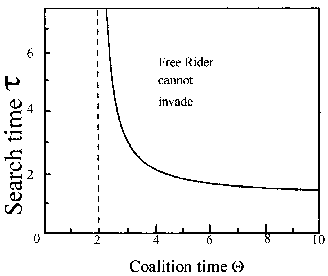
>>Cooperative groups could be affected by free-riding defectors who accept a shared resource without returning the favour.
>>Enquist & Leimar (1993) modelled a population of organisms who could only reproduce after an exchange of resources.
>>They showed the free -rider are successful only the the coalition time (time to persuade others to invest) and the search time to find other players were low.


-->The size of human groups and the dispersed nature, in hunter-gatherer societies typical of most of our evolutionary history must have made free-riding common.
-->Cooperating humans must therefore have evolved counter-strategies including:
     =>Confine cooperation to kin (kin altruism)
     =>Information exchange to limit free-riders (dialect)
     =>Impose costs on new players (dowry)
     =>Cheater detection mechanism


Thinking 1-The Nature of Rationality

Are humans rational?


In principle, what constitutes a rational decision?
Can people actually make that decision?
What are the circumstances that affect rational decision making?
What might be the explanations for rational and irrational decisions? And the validity of those explanations?


Three kinds of theory:
  1. Descriptive models-models of how thought processes operate irrespective of whether the decision is good or bad.
  2. Prescriptive models-models that state how we ought to think in order to make the best decisions.
  3. Normative models-evaluate a decision in terms of the goals of the decision maker, a decision is good if it reaches these goals.
Rational thinking is normative.
--A decision is good when to enable;es the decision maker to reach their goals.

A rational decision maximises utility.
--Where utility is the extent of goal achievement.

Rationality is subjective.
--We all have different goals, what is rational to one might be (irrational/not as rational) to another.


Rational Choice Theory 

->social physics: economic principle
->individuals always make prudent & logical decisions which provide them with the greatest benefit/satisfaction
->also in their highest self-interest
->people always try to maximise their advantage and minimise their losses.
->All humans base their decisions on rational calculations, act with rationality when choosing, and aim to increase either pleasure/profit.
->all complex social phenomena are driven by individual human actions
->Utility functions & probability distributions

A choice between 2/more alternatives, rational choice=option with the highest value or utility.
Value is often numeric monetary, utility is abstract.

Choices under uncertainty: 
--if the outcomes are uncertain, probability of receiving the outcome*expected value EV.

  • A.  $100 with 50% probability, EV=$50
  • B.  $1000 with 2% probability, EV=$20

Expected Utility Theory:
--We can't know the future, any choice could be a gamble and we can apply Expected Value to Expected Utility, although some options have a near certain outcome while other a near zero outcome.

                                                        God exists    God does not exist
  • Option A–Live holy life             heaven          bit less fun life
  • Option B–Live secular life           hell              average fun

--We can assign utilities to each outcome and the probability to receive them.

  • Bit less fun, Ua=-1,   Average fun, Ub=0,   Heaven, Ua=100,   Hell Ub=-100
  • P(God exists)=0.5;   god does not exist=1-p(God)=0.5
  • Option AEUa= (0.5*100)+(0.5*-1)=49.5
  • Option B–EUb= (0.5*-100)+(0.5*0)=-50
--The rational choice is the option with the highest expected utility.
--Expected utility states what a rational choice is, being a normative theory.


Some arguments:
1. The long-run argument.
--EU is based on probabilities and gambles; the rational choice is based on an average of what would happen if the same decision were to made (on a number of successive occasions/a large number of people were to make the same decision).

2. The arguments from principles/the Choice Axioms.
--Weak ordering
       ->We must always be able to say we prefer one over the other or neither, in any set.
       ->x>y/x<y/x=y
       ->As we can express the utility of an option as an integer, the choices must be comparable.
--Transitivity
       ->As utility is expressed as an integer, our choices must be transitive.
       ->x>y, y>z, therefore x>z
--The Sure-thing principle
       ->Arises from the multiplications of probability, not the numerical status of utility.
       ->If there is some state of the world that leads to a particular outcome irrespective of our choices then it is cancelled out of the equation and we should not let it affect our choices.
       ->One should make the same decision either if he knew that an event E will obtained, if he knew the negation of event E obtained, and also if he knows nothing about event E.
--The utility of wealth
       ->St.Petersburg Paradox (Peter tosses a coin and agrees to give Paul one ducat if he gets heads on the very first throw, two ducats if he gets it on the second, four if on the third , eight if on the fourth, and so on, so that with each additional throw the number of ducats he must pay is doubled.)

       ->The expected value of this gamble is infinite. However, one would sell the chance for twenty ducats that although the EV is infinite, the subjective utility is low.
       ->Bernoulli suggested that EV≠EU, instead the utility of wealth is proportional to its logarithm. Each additional unit of wealth worth less than the previous one. The utility of additional currency units decreases as the number of currency units increase.
       ->Thus the extra utility of the high winnings is no longer high enough to compensate for the very low probabilities.
       ->If I have $1000000 I care less about an additional $500 than if I only have $1000.


Three violations of normative theory:

1. The Allais Paradox

>>Maurice Allais (1953) showed that people do not maximise expected utility and violate Savage's choice axiom, the sure-thing principle.

Situation 1
A  $10 000          p=1
B  $50 000          p=0.1
     $10 000          p=0.89
     $0                   p=0.01
Situation 2
C  $10 000          p=0.11
     $0                   p=0.89
D  $50 000          p=0.1
     $0                   p=0.9


--Most people prefer 1A ($10 000 for sure) and 2D (10% chance 50 000).
--We should subtract common outcomes and outcomes with zero utility from the equation because these should not affect out choice.
--As result, Situation 1 becomes A<B.

  • u(10 000)<0.89 u(10 000)+0.1 u(50 000)
And reduces to

  • 1-0.89=> 0.11 u(10 000)<0.1 u(50 000)
A preference for $1100 over $5000 does not maximise expected utility.

--Situation 2 becomes C<D.

  • 0.11 u(10 000)<0.1 u(50 000)

Although the utilities are the same the removal of common outcomes ($0) results in a now rational preference for the option that maximises expected reality.


2. Risk seeking vs. risk averse behaviour

>>Would you prefer a certain gain of $3000/an 80% chance of gaining $4000, otherwise nothing?
--Most people prefer a sure gain, although the EV of the risky option is higher.

>>Would you prefer an 80% chance to lose $4000, otherwise nothing/ a certain lose of $3000?
--Preferences are reversed, most people prefer the risky option.

>>Would you prefer a certain gain of $5/ a 0.001 chance of gaining $5000?
>>Would you prefer a certain loss of $5/ a 0.001 chance of losing $5000?
--When probabilities are smaller people become risk seeking for gains and rick averse (prefer the sure thing) for losses.


3. People do not integrate prospects with existing assets.

>>Imagine that you have been given $1000. Would you choose a 50% chance go gaining $1000/a certain gain of $500?
>>Imagine that you have been given $2000. Would you choose a 50% chance of losing $1000/a certain loss of $500?
--Utility theory suggest that we should integrate decision outcomes with our current assets (it should be A=2000*0.5/1000*0.5 or B=$1500).
--However, most people prefer a certain low gain and uncertain high loss.
--They made decisions according to the situation without associating current assets.


**Rationality in evolutionGigerenzer (2000)-Heuristics were evolved in the Environment of Evolutionary Ancestry (Pleistocene period). So utility is redefined as genetic fitness. Heuristics evolved on an ad hoc basis to satisfy particular problems.