->The ultimatum game
-->The proposer is given $10 but has to share it with a responder, they have to decide how to split a sum of money. The proposer suggests a sum to the responder who must either accept or reject the offer. If the responder rejects the offer both player lose all. No discussion is allowed and both players are anonymous.
-->RCT suggests that the proposer should offer the minimum amount possible and the responder should always accept any offer no matter how small as this maximises EU for each player. However, the median offer is about 40-50%, offers below 20% are usually rejected. In deciding to share, people can be more altruistic than we might expect and revengeful.
->The dictator game
-->Same situation with the ultimatum game, but this time the responder is completely passive that they must accept the offer.
-->It is a behavioural model of charitable giving. According to a narrow view of RCT, the proposer should never play this game and should always pocket all the endowment.
-->In Kahneman, Knettch & Thaler 1986's study, proposers can choose to offer a 50:50 split or a 90:10 split with anonymous responder, 76% chose to divide the money equally. In the next round, the past behaviour was known to the proposers, this resulted in punishment for the unequal proposers in the previous games. Altruistic punishment
The prisoners' dilemma
--First described by Von Neumann & Morgenstern.
--Two people are suspected of committing a crime. There is not evidence to secure a conviction so only a confession will do. They are held in separate cells and given the option of staying silent(cooperating) or confessing(defecting=blaming the other).
--The dilemma arises because whatever the other person does it is optimal for each one to cooperate.

>>In such situation, confession=defection against the other and not confession=cooperation.
>>If one confessed(defects), the other gets the sentence and the confessor goes free.
>>If both of them confess(defect), they both get the sentence.
>>If neither of them confesses(cooperate with each other), they both get a nominal sentence as the evidence is circumstantial.
>>The rational decision is always defect for own good.
Social Dilemmas
->Involve a decision in which there is a trade off between one own interests (to defect) and the interests of the group.
->Individual rationality leads to collective irrationality that I have to forfeit utility for the common good.
->Defection are more common in humans than animals.
->There are some possible cause to the defection.
=>Krebs (1975)-Participants observed a stooge in a gambling experiment which they either won money /received and electric shock. Participants exhibited higher GSR & heart rate when they perceived the stooge as similar than dissimilar. More was shared with similar stooges when they were given an opportunity to share their reward with those who had done badly. Empathy?
=>Hershey (1994)-The willingness to receive vaccinations against hypothetical illness of participants were examined. Either one that provides immunity(prevents transmission but not acquisition therefore everyone need to be vaccinated) and one that provides immunity from symptoms but not transmission. People are more willing to take the immunity option when more people in the population/greater proportion of the population are taking the vaccine. Fairness?
=>Messick (1985)-In an iterated game participants chose to defect either to avoid falling too far behind others/to prevent the other from doing better than them. This occurs despite the participants' awareness that they will perform worse than necessary.
=>Dawes et at. (1986)-Participants were given a voucher that could be exchanged for $5, they could either keep it or donate it to a pool. If a certain number donated their $5 then each would receive a $10.
>The Money-back guarantee condition: If too few donation were received then they would get their money back. There was no reason to fear donation as they would lose nothing. Such condition did not increase the cooperation rate relative to the control group.
>The Enforced-contribution condition: Non-contributor would lose their $5 & the reward if enough people met the target. Only enforces contribution increased cooperation. Greed is often the basis for defection.
->People often make comparison between behaviour of their own and others in the group. If everyone is doing something then it would be unfair of me not to.
->We always exhibit peevish behaviour to prevent others from doing better than us.
The iterated prisoner's dilemma
--Playing the prisoner's game again & again.
--The iterated form is important in evolution (selfish gene) primae facie suggests that we should all look after our own backs and defect everytime.
--Single instance games of PD have a rational decision-always defect, since defecting is a dominating strategy. However, with iterative PD defecting is not optimal since an irrational choice of mutual cooperation will cause net gain for both players.
--This leads to the "Problem of Suboptimization" that optimum play for each participant leads to a globally sub-optimal outcome.
--The iterated PD allows us to understand the evolution of cooperating species from an inherently selfish genetic pool.
->Axelrod & Hamilton (1981) were interested in political relationships and reproductive strategies in nature. They wanted to study the nature of cooperation amongst nations.
->They set up a computer tournament in which academics from all over the world sent different strategies. The winning strategy, Tit for Tat was sent in by social psychologist Rappoport.
->The Free Rider strategy-Always defect no matter what was the opponent's last move. This is a dominant strategy against an opponent that has a tendency to cooperate.
->The Always Cooperate strategy-Always cooperate no matter what the opponent's last move was. This strategy could be terribly abused by the Free Rider strategy or any strategy that tends towards defection.
->Tit for Tat strategy-The action depends on the opponent's last move. Be Nice, always cooperate on the first move. Thereafter, always choose the opponent's last move as your next move. Be regulatory, it punishes defection with defection; be forgiving, it continues cooperation after cooperation by the opponent. Be clear, it allows opponent to predict the next move easily, thus mutual benefit is easier to attain.
->Suspicious Tit for Tat strategy-Always defect on the first move, thereafter, replicate opponent's last move.
**The Tit for Tat strategy won twice in the Axelrod's Tournaments where professional game theorists submit their own programs to play the iterated PD game. Each strategy played every other, a clone of itself, and a strategy that cooperated and defected at random hundreds of times.
To explain the success of Tit for Tat, we could look on survival of a species. Suppose there are a larger number of animals of a single species, and their interaction are the form of the PD in which each organism can remember the outcomes of its interactions with other organisms. In simulations of this kind we see that Tit for Tat is most likely to survive and hence evolve.
But how do we get people to behave in such way for real-life social dilemmas?
How to ensure cooperation?
-->Social values-Participants with different social values behave differently, some prefer to maximise the difference in outcomes between self and others, some prefer to have equal outcomes. (McLintock & Liebrand, 1988)
-->Communication-Participants are more likely to cooperate if they are allow to communicate. (Dawes et al., 1977)
-->Shared group identity-Participants are more likely to cooperate if they are i identified as being members of the same group as other players. (Kramer & Brewer, 1984)
The problem of free riders
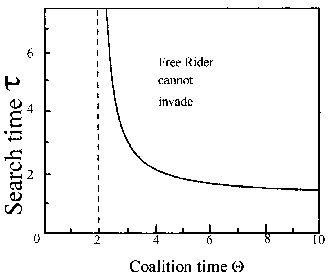
>>Cooperative groups could be affected by free-riding defectors who accept a shared resource without returning the favour.
>>Enquist & Leimar (1993) modelled a population of organisms who could only reproduce after an exchange of resources.
>>They showed the free -rider are successful only the the coalition time (time to persuade others to invest) and the search time to find other players were low.
-->The size of human groups and the dispersed nature, in hunter-gatherer societies typical of most of our evolutionary history must have made free-riding common.
-->Cooperating humans must therefore have evolved counter-strategies including:
=>Confine cooperation to kin (kin altruism)
=>Information exchange to limit free-riders (dialect)
=>Impose costs on new players (dowry)
=>Cheater detection mechanism

没有评论:
发表评论